Chapter 5: How we work
Communication
A growing team means we cannot talk to everyone everyday, just have a look at the picture below. With three or four people communication is easy. From five people up, things become more complex. We try to find a good balance between communication flow and getting things done.
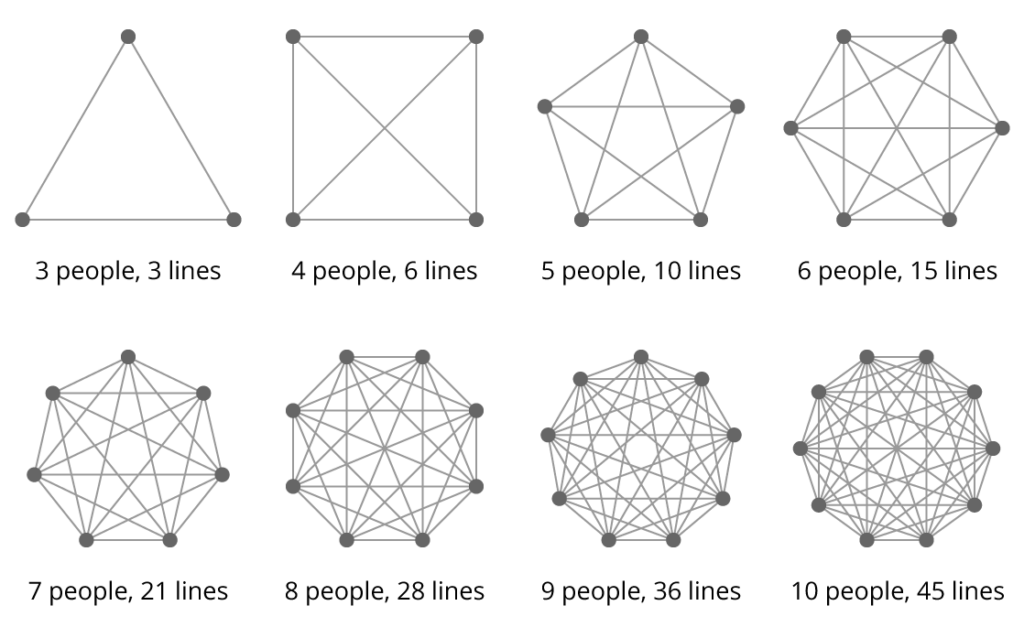
As communication experts we know that “you cannot not communicate” (Watzlawick). Especially in a remote setting we need to add some more explicit communication (like a short “hello” in the right channel) to compensate for the lack non-verbal signals.
Say it!
In every team there are conflicts and stressful situations. But we respect and trust each other. We have learned that it is always better to “say it!” if there is something going on that doesn’t feel right for you right now. Don’t keep conflicts for yourself and let them grow, tell the other person about your feelings and impressions and let’s find a solution together.
Pitch your ideas
You have a good idea to improve Edkimo? Don’t keep it for yourself! Write it up on an idea ticket. This is the best way to make sure it won’t get lost and find it’s way to the founders team. Edkimo is a team effort, and we will help you fill your good ideas with life.
Weekly cycles
We work in weekly cycles on the development side and this helps us to structure the rhythm and groove of the whole company. In a weekly all-hands meeting at the end of the week everyone shares what he or she has been working on with the whole team. Our team members have one short one-on-one meeting at the beginning of the week with their manager.
Balanced
We limit our full-time work week to a maximum of 40h. You have a life, friends and family, and you need time to relax, for yourself and to get enough sleep. This will pay off in the long-run for you, your health, your relationships and our company.
Management-on-demand
Management at Edkimo is a part-time job, we have no full-time managers. Everybody in the team has to get things done. This is why we highly appreciate self-managers, that means team members who set their own goals, break the job down into tasks, prioritize and get things done. However, if you need support from your manager to set up and prioritize your weekly tasks, the one-on-one meetings are the best time to do that.